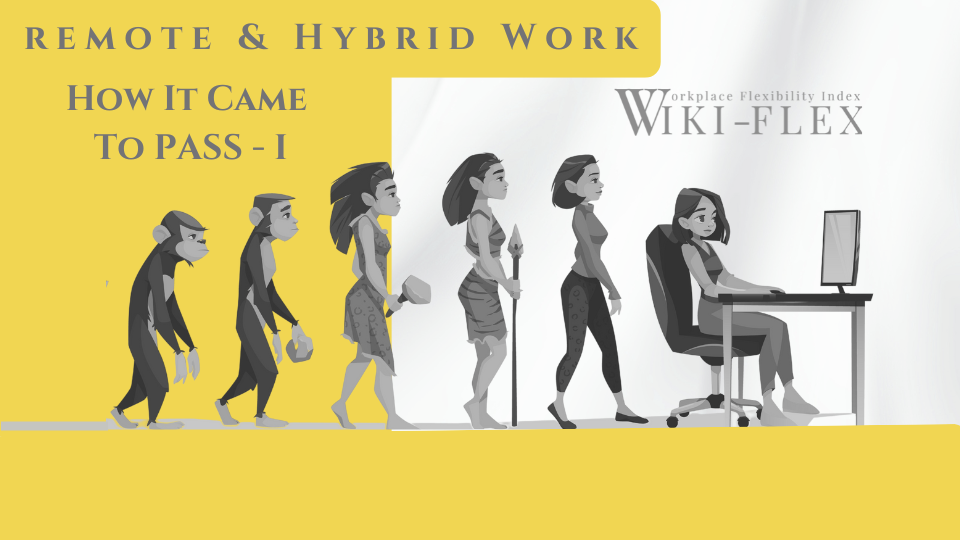
The pandemic of 2020 was credited with making remote work mainstream. It was a massive saving grace for the economy to be able to weather out the pandemic for sure. But a lot of successes had to happen and even more failures were needed to allow us this saving grace.
What were the events that even enabled us to leverage remote work to begin with? Sometimes a reminder of the basics helps. These reminders can also help you understand the differences between enablement and adaptation.
Adaptation, whether to remote or hybrid work, requires risk management; a fact nothing can wish away. And to improve the present, one must understand the past.
But moving back to enablement, many, many factors have contributed (there always are; unless one is satisfied with easy but incomplete answers)…
…for today, let us just look at the technological developments that led to this shift.
From the Home to the Factory
Before the Industrial Revolution, craftsmen, traders, artisans and painters worked from the comfort of their homes. This was natural to them because there were no fixed workplaces at that time.
After the Revolution, however, people moved to factories and they were now required to be present there to work. The concept of travelling from one’s house to a fixed office space was born here.
The Technology Behind Remote Work
If we look at World Wars I and II and the technological advancements that took place during that time, the list is long.
But in the context of communications, radio, telephone and telegraph were the most used mediums for civilians and soldiers alike. In 1957, the space race gave communication further impetus, and satellites went on to become a key part of the global communication realm.
In 1969, the Advanced Research Projects Agency Network (ARPANET), built on J.C.R. Licklider’s idea of a network of computers, went live. It was the first public packet-switched computer network, and it let computers in different physical locations share digital resources.
And in 1973, Martin Cooper of Motorola made the first call from a handheld mobile phone; personal computers followed later in the decade.
These were all major developments that went on to support remote work eventually.
The Birth of Telecommuting
‘Telecommuting’ as a phrase was first introduced by NASA engineer Jack Nilles in 1973. Even then, he believed that it was a feasible alternative to commuting that would resolve issues of nonrenewable resources and traffic.
In 1979, five IBM employees were allowed to work from home as part of an experiment. In just another four years, 2,000 IBM workers were remotely working and this made the company one of the pioneers of remote working. By 1987, roughly 1.5 million Americans were telecommuting.
Remote Work in the Internet Age
Then came the 21st century and along with it the Internet Age which accelerated the growth of cloud computing, the World Wide Web and therefore, the easy access, distribution and browsing of information.
In 2000, the Department of Transportation and Related Agencies Appropriations Act required every executive agency of the United States government to have a telecommuting policy for its eligible employees.
The year 2005 saw the first official co-working space in the world. It was created by Brad Neuberg in San Francisco.
Remote work further took off because of the emergence of garage startups where young entrepreneurs worked on their laptops with a small set-up.
In 2010, remote work, artificial intelligence and SaaS companies evolved. In the same year, President Barack Obama signed into law the Telework Enhancement Act. It requires all federal agencies to create work-from-home policies for every eligible employee.
Since then, the remote workplace has only grown through the years and innovations like social networking tools for enterprises like Microsoft Teams and quick video and messaging chat platforms like Zoom and Google Meet have supported it. Between 2010 and 2019, the share of employees in the United States working remotely at least once a week nearly quadrupled, from 9.5 per cent to 36 per cent.
To conclude, the remote and hybrid team model of working has a rich history. For long, small groups of individuals, leaders and companies have been practising the model. But the Covid-19 pandemic has brought remote and hybrid work to a point of no return.
The coming years will continue to see a further shift towards enhancing remote work policies, investing in security technology and effectively accessing larger pools of talent.
Check out our follow-up blog as we go even farther back in history.