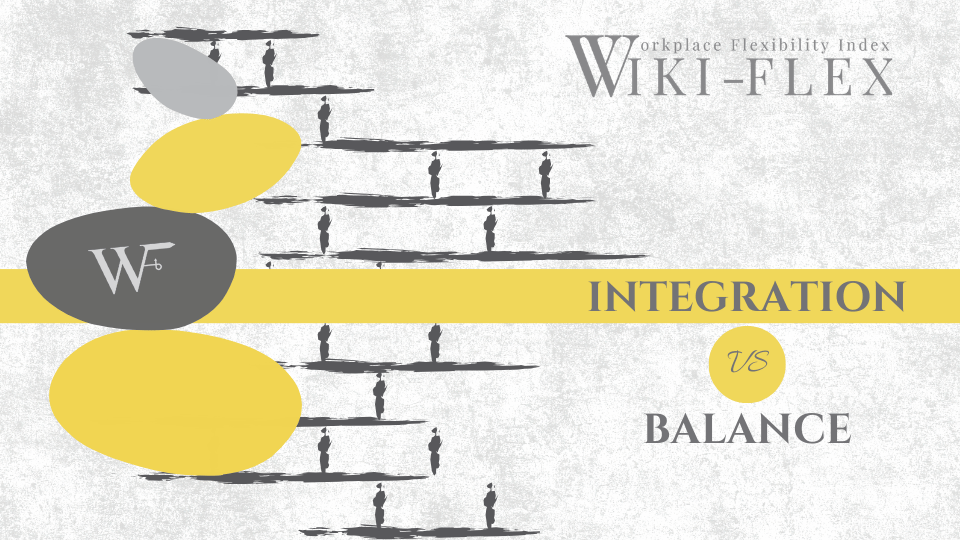
A lot has been said about work-life integration rather than work-life balance in remote or hybrid work.
Arianna Huffington raised this some time ago as well.
But What Is It?
As we keep talking about integration rather than balance, let’s take a look at what the two actually mean.
In some quarters, integration is looked upon as an encroachment by the employer into the employee’s space. That’s a rather limiting perspective.
As much as we’d like to create firm distinctions between the two, our work and personal lives are interconnected. And in a remote or hybrid work world, they’re even more closely knit together than before.
With our workstations inside our house, steps away from the bedroom, kitchen, and the kids, work and personal life coexist. For many, this allows them to perform both better, not having to divide their mind between two places. For others, it can lead to a compromise on both counts.
Work-life balance separates work and life into two sections and seeks to establish an equilibrium where a person devotes undivided attention to each segment during a set period/fixed hours. But work-life balance, as an idea, wants perfection and rigidity that is nearly impossible in today’s world.
When you work from home and the gardener rings the bell for his dues, do you not get up to attend to him? With twenty-four-seven communication mediums, are you not tempted to check a work email/message that pops up after your shift for the day ends? Isn’t it easier to bring the kid to your room and keep an eye on her while you continue taking calls?
Work-Life Balance
The problem with work-life balance is that it leaves no room for adaptability, something that is required a lot now that we are actively moving towards remote and hybrid work.
On the other hand, work-life integration recognises and accepts how intricately the professional and personal realms of our lives are blended and how one affects the other. It fixes the flaws of work-life balance and enables employees to live more fulfilling lives where they carry out their professional and personal roles.
One of the biggest advantages of work-life integration is that it does not enforce compartmentalisation. As an employee, you may feed the baby while attending a virtual team-building exercise, fold the laundry while you wait on a response from your boss, and answer personal emails during work hours and vice versa. When you tend to other areas of your life while taking care that work is not compromised, it is a win-win situation for all.
Work-Life Integration
Work-life integration does not pit these two areas of your day against each other and instead promotes flexibility and comfort while lessening sacrifice and burnout.
While it may look like work-life integration is the sole responsibility of an individual/employee and how they navigate it, employers have a crucial role to play in a remote or hybrid workplace.
Employers and team heads should humanise employees and workers and look at them as people with a life beyond work. This will create a steady shift in work culture and eventually, employees will find their employers more accepting of their responsibilities outside their job.
What’s the Answer?
Work-life integration can thrive only if it is implemented correctly.
Employees should keep their team leaders in the loop as to how they’re going about fusing their work with their life. The latter should give suggestions, allow freedom and put faith in workers.
This is hard.
Very hard.
Like with anything, there will be those rare times when work pressures conspire to overlap with inappropriate behaviour of a minor fraction of employees. This behaviour may lead to a knee-jerk reaction of throwing the baby out with the bathwater.
On the other hand, an incomplete understanding of the situation by some supervisors may lead to integration turning into encroachment. In such cases, for some employees, the unification of work and life results in taking a lot on the plate from both sides only to see everything falling apart.
It’s important to identify and address these as isolated instances but deserving of attention nonetheless.
It’s worth it.